
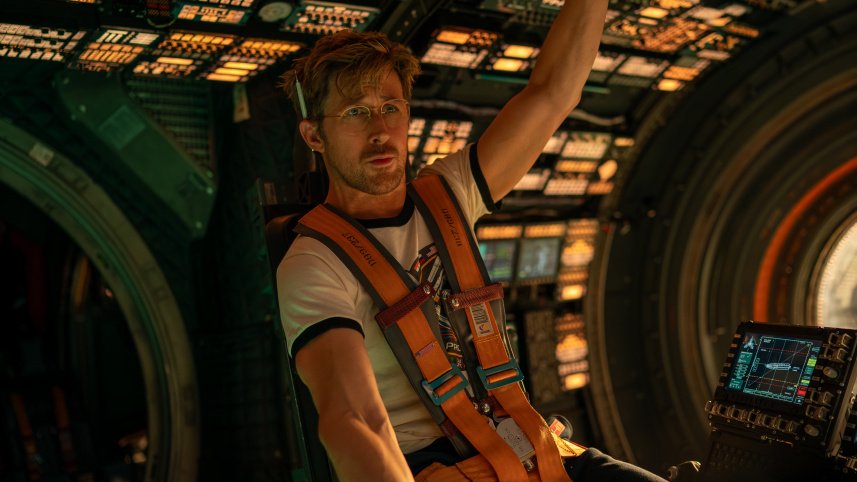
Project Hail Mary has been widely praised for its optimism, for being “hopecore”, and there’s undeniably plenty here that is fun. It’s lively and carried by an effortlessly charismatic Ryan Gosling. It follows Ryland Grace, who wakes up alone in space with no memory of how he got there, only to slowly realise he’s on a mission to stop the sun from dying and wreaking havoc on life on Earth. The film is engineered to please, and for long stretches, it succeeds.
But that very impulse to constantly please, to keep things breezy, becomes its biggest limitation.
The film feels locked into its own tonal box. It insists on being “fun” even when the narrative often demands something heavier. When Grace first encounters an alien spacecraft, the film rushes to avoid any real sense of awe or terror. Instead of a moment of brief existential rupture, it becomes just another beat in a buoyant rhythm. It plays like a subversion of the first-contact trope, but ends up robbing both Grace and the audience of a rollercoaster of emotions.

One could argue that Grace’s constant quipping reveals his character, but the film rarely looks beneath the surface. He often feels faintly aware of the audience watching him. When authentic human emotions are sacrificed for the sake of maintaining a “safe” tone, immersion falters.
The fragmented flashbacks seem untethered to sensory triggers or internal struggle, which might have worked as non-linear storytelling. But because Grace’s amnesia is initially framed with high stakes, the film’s failure to clarify what he gradually remembers versus what is being told to us creates a disconnect between his journey and the viewer.
The film’s most compelling narrative choice is the revelation of why Grace took on this self-sacrificing mission, a brilliant subversion of the reluctant hero archetype. The relationship between Grace and his alien buddy, Rocky, is the heart of the story, and it mostly works. However, if a story hinges on a bond, that bond needs more meat to it than banter. It needs evolution that reveals deeper dimensions of each character beyond anecdotes, without which the emotional payoffs feel muted. This also manifests as a pacing issue. Exceeding two and a half hours, the film doesn’t deepen the inquiry of its central dynamic enough to justify its length.